

Getting Started with Scilab – Beginners Tutorial
SCILAB provides a powerful computation environment along with a rich collection of numerical algorithms for both the engineering and scientific community.
SCILAB provides a powerful computation environment along with a rich collection of numerical algorithms for both the engineering and scientific community.

What is Python? Python is an open source general purpose programming language. It is designed in such a way to improve software quality, developer productivity, program portability and component integration. Python gives more importance to its code readability and its syntax allows programmers to program their idea in fewer lines of code than other programming languages like C does. It is used all round the globe for web designing, system programming, user interfaces, product customization, numeric programming etc. Why Python? Python language is...
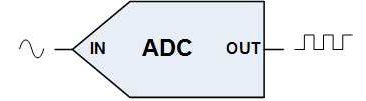
Analog to Digital Converter (ADC) is a device that converts an analog quantity (continuous voltage) to discrete digital values. This is very useful when we want to do some processing on physical quantities, which are normally analog in nature. Most of the PIC Microcontrollers have built in ADC Module. Here we are using PIC 16F877A for demonstrating the working. ADC_Symbol ADC of PIC Microcontrollers have 5 inputs for 28 pin devices and 8 inputs for 40/44 pin devices. It is a...
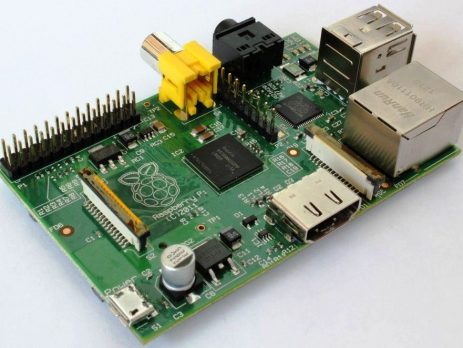
Raspberry Pi is an ultra low cost credit card sized computer developed by Raspberry Pi Foundation with an intention to teach computer programming to school students. You can setup a computer with your home TV under 60$. Please read the article Raspberry Pi for more details. You need the following items to get started with Raspberry Pi : Class 4 SD Card (minimum 4GB) SD Card Reader to write OS files to the SD Card (You may use your laptop's...
I hope that you have already read the first tutorial of Hi Tech C, LED Blinking using PIC Microcontroller. In that tutorial we blink LEDs connected to PORTB by writing to entire PORT and TRIS registers. In some cases we may want to set or reset individual bits of these registers. For that we can use the bit addressable feature of these registers. We have already seen in the previous...
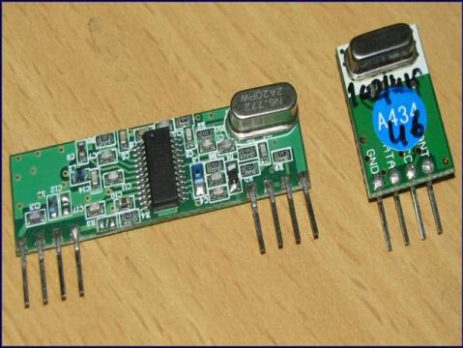
A wireless radio frequency (RF) transmitter and receiver can be easily made using HT12D Decoder, HT12E Encoder and ASK RF Module. Wireless transmission can be done by using 433Mhz or 315MHz ASK RF Transmitter and Receiver modules. In these modules digital data is represented by different amplitudes of the carrier wave, hence this modulation is known as Amplitude Shift Keying (ASK). Radio Frequency (RF) transmission is more strong and reliable than Infrared (IR) transmission due to following reasons : Radio...
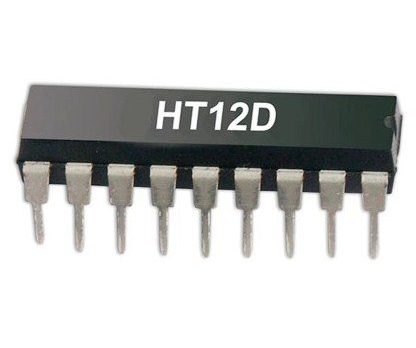
HT12D is a 212 series decoder IC (Integrated Circuit) for remote control applications manufactured by Holtek. It is commonly used for radio frequency (RF) wireless applications. By using the paired HT12E encoder and HT12D decoder we can transmit 12 bits of parallel data serially. HT12D simply converts serial data to its input (may be received through RF receiver) to 12 bit parallel data. These 12 bit parallel data is divided in to 8 address bits and 4 data bits. Using...
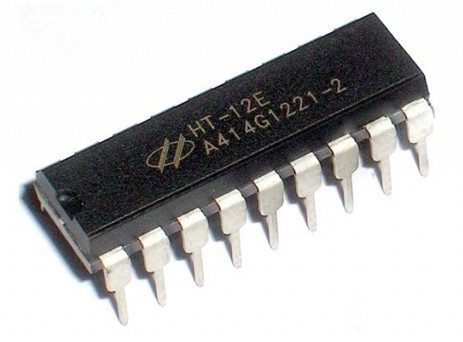
HT12E is a 212 series encoder IC (Integrated Circuit) for remote control applications. It is commonly used for radio frequency (RF) applications. By using the paired HT12E encoder and HT12D decoder we can easily transmit and receive 12 bits of parallel data serially. HT12E simply converts 12 bit parallel data in to serial output which can be transmitted through a RF transmitter. These 12 bit parallel data is divided in to 8 address bits and 4 data bits. By using...